What will help people understand, participate and act?
AR, AI, 3D and spatial interfaces are tools for creating an experience. Select them around the challenge, audience and conditions of use, then test how they work together.
AI-powered experiencesHow do you turn content into a conversation people can lead?
Design characters and conversational interfaces around defined knowledge sources and a purpose. AI enables choices and questions within a brand, training or visitor experience.
Explore this challenge AI & machine learningHow can AI help someone understand and take action?
Evaluate AI around a task: conversation on defined content, a tailored route or a response to a user’s choice. Development and integration are scoped for each project.
Explore this challenge AR & VRHow do you let people experience what is difficult to show?
Augmented reality (AR) adds content to an existing environment; virtual reality (VR) creates a digital setting. Choose the encounter around users, content and operating conditions.
Explore this challenge Augmented reality · ARHow do you add something people can discover in the real world?
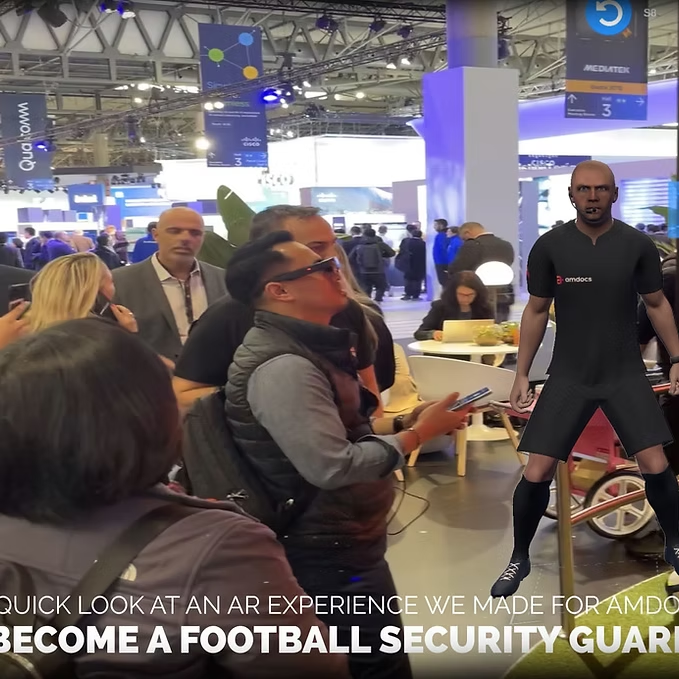
Augmented reality (AR) places digital characters, games and information within a physical setting. A product, package or place can become the entry point to an experience.
Explore this challenge Digital experience infrastructureHow do you connect content, users and operation in one experience?
An experience also needs ways to distribute and update content and connect data. Cloud and integration requirements are defined around project scope and the systems involved.
Explore this challenge Holographic contentHow do you give a character or product a presence within a space?
Three-dimensional content can appear within a setting through AR or a suitable display system. Presentation is chosen around audience, viewing angle, lighting and budget.
Explore this challenge Spatial storytellingHow do you turn a story into something the audience is inside?
Connect narrative, place and action in a journey people discover through participation. AR, characters and 3D each have a role within the story.
Explore this challenge Responsive interactionHow do you make an experience respond to a user’s choice?
An interface can change content after a choice, answer, movement or conversation. Design clear responses so people understand what happened and how to continue.
Explore this challenge Interactive environmentsHow do you make a space invite people to participate?
Screens, content, sensors and AR can turn a space into an active journey. Start with how people enter, move and choose what to try.
Explore this challenge Sensors & connectivityHow do you connect a physical action to a digital response?
A sensor, connected object or controller can trigger content and exchange information within an experience. Design around the action and conditions of the location.
Explore this challenge Mixed reality · MRHow do you connect digital content with the place you are in?
Mixed reality connects digital content with a physical setting. Plan the relationship between the space, device and the action a person takes.
Explore this challenge Responsive spacesHow do you make a space change when people take part?
Content can respond to movement, presence or shared participation. Design a clear relationship between what people do and what appears around them.
Explore this challenge Smart-glasses experiencesHow do you keep people’s eyes on the world while adding useful content?
AR glasses can place an explanation, character or story beside what a person sees. Experience design starts with the device, usage time and environment.
Explore this challenge Spatial interfacesHow do you let people act within three-dimensional content?
A spatial interface lets people select and activate content within an environment. Gestures, touch, gaze or a phone are chosen around the device and user.
Explore this challenge